

Introduction
Carbon steel blind flange weight is a critical engineering variable, not just a shipping spec. It directly impacts pipe support design, structural loading calculations, fabrication planning, and procurement accuracy across carbon steel piping systems.
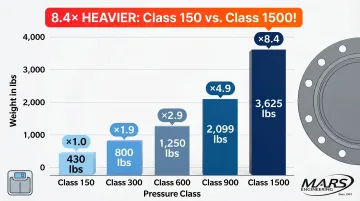
A Class 150 blind flange at NPS 24 weighs approximately 430 lbs. At Class 1500, that same nominal pipe size exceeds 3,600 lbs — a difference that fundamentally changes how systems are designed and supported.
Understanding how pressure class, nominal pipe size (NPS), and ASME B16.5 dimensional requirements govern weight is essential for correct flange specification and system reliability. Engineers who misapply weight values or fail to account for pressure class differences risk undersized supports, unsafe rigging operations, and costly field corrections.
This article covers dimensional parameters, weight charts by pressure class (Class 150 through 2500), calculation methodology, and the specification errors most likely to cause problems in the field.
TL;DR
- Carbon steel blind flanges terminate piping runs with no bore; weight increases significantly with NPS and pressure class
- ASME B16.5 covers NPS ½"–24" dimensions; ASME B16.47 takes over for NPS 26–60
- Weight is driven by outside diameter and flange thickness—both increase from Class 150 to Class 2500
- ASTM A105 carbon steel density at 7.85 g/cm³ is the basis for all weight calculations
- Weights are pressure-class specific: values from one class chart cannot be applied to another
What Carbon Steel Blind Flange Weight Represents in Piping System Design
A blind flange is a solid, unpiped disc bolted to a flanged pipe end to completely close off flow. Unlike weld neck or slip-on flanges, a blind flange has no bore and no neck, making it the heaviest flange type at any given NPS and pressure class because it retains maximum material mass per diameter.
Blind flange weight is a design-governing parameter — one that directly impacts:
- Pipe support span calculations (per ASME B31.3)
- Structural loading on adjacent piping and support structures
- Lift and rigging requirements during installation and maintenance
Weight is a derived characteristic resulting from outside diameter (OD), flange thickness (both driven by pressure class), and material density. Change any one variable, and weight changes predictably.
Why carbon steel is the baseline: ASTM A105 (forged carbon steel) is the most common grade for blind flanges in ambient- and higher-temperature service, with a density of approximately 7.85 g/cm³. For stainless steel or alloy materials, weights must be adjusted using density ratios—typically 1.01–1.02 for 304/316 stainless steel versus carbon steel.
Weight also scales non-linearly with NPS and pressure class. The difference between classes at the same pipe size can be dramatic, for example:
- NPS 24 Class 150 blind flange: ~430 lbs (195 kg)
- NPS 24 Class 1500 blind flange: ~3,625 lbs (1,631 kg)
That 8.4× increase for the same nominal pipe size reshapes support design, installation procedures, and material handling requirements at every stage of a project.
Key Dimensional Parameters That Define Carbon Steel Blind Flange Weight
ASME B16.5 specifies the dimensions that drive weight: outside diameter (OD), flange thickness (C), raised face diameter, bolt circle diameter (PCD), number and size of bolt holes. All these parameters are pressure-class dependent.
Outside Diameter (OD) and Flange Thickness
OD and thickness are the two dominant contributors to blind flange weight. As pressure class increases, both dimensions grow to handle greater internal pressures.
NPS 12 blind flange dimensional comparison:
| Pressure Class | Outside Diameter (OD) | Minimum Thickness | Weight Increase Factor |
|---|---|---|---|
| Class 150 | 19.00 in (482.6 mm) | 1.25 in (31.8 mm) | Baseline |
| Class 1500 | 26.50 in (673.1 mm) | 4.88 in (124.0 mm) | ~6× heavier |
Because a blind flange has no bore, it retains all material in the disc area. This makes it substantially heavier than a weld neck or slip-on flange of the same NPS and class.
Bolt Circle and Raised Face
Bolt circle diameter (PCD) and the number of bolt holes grow with both NPS and pressure class, requiring more material for the bolt pattern area. Raised face (RF) dimensions are:
- 2 mm (0.06 in) height at Class 150-300
- 7 mm (0.25 in) height at Class 400-2500
While RF is a minor contributor to total weight, it's critical for gasket seating load calculations.
Dimensional tolerances per ASME B16.5:
- Thickness tolerance: +1/8" / -0" for flanges 18" and smaller
- OD tolerance: ±1/16" for sizes up to 24"
These tolerances matter when machined components must seat precisely against flange faces or bolt patterns. For mating parts such as bushings, alignment pins, or custom fittings, M.A.R.'s Engineering holds tolerances to 0.0001 inches and surface finishes to 4 microinches through centerless grinding, CNC turning, and live tooling.
Carbon Steel Blind Flange Weight Chart by Pressure Class (ASME B16.5)
The following tables present reference weight data for carbon/alloy steel blind flanges (density ~7.85 g/cm³) for NPS 1/2" through 24" per ASME B16.5. Published values vary slightly by source due to rounding and manufacturing tolerances.
Class 150 and Class 300 Blind Flanges
| NPS | Class 150 Weight | Class 300 Weight |
|---|---|---|
| 1/2" | 2 lbs (0.9 kg) | 3 lbs (1.4 kg) |
| 1" | 3 lbs (1.4 kg) | 5 lbs (2.3 kg) |
| 2" | 6 lbs (2.7 kg) | 11 lbs (5.0 kg) |
| 4" | 14 lbs (6.4 kg) | 28 lbs (12.7 kg) |
| 6" | 23 lbs (10.4 kg) | 48 lbs (21.8 kg) |
| 8" | 47 lbs (21.3 kg) | 85 lbs (38.6 kg) |
| 12" | 123 lbs (55.8 kg) | 185 lbs (83.9 kg) |
| 16" | 200 lbs (90.7 kg) | 340 lbs (154.2 kg) |
| 20" | 305 lbs (138.3 kg) | 550 lbs (249.5 kg) |
| 24" | 430 lbs (195.0 kg) | 800 lbs (362.9 kg) |
Weight milestones for rigging planning:
- Class 150 NPS 24: ~430 lbs — manageable with standard rigging equipment
- Class 300 NPS 24: ~800 lbs — approaching the upper limit for manual handling
Class 600 and Class 900 Blind Flanges
As pressure class increases, weight escalates sharply — particularly above NPS 12". Class 600 and 900 flanges require mechanized lifting for most large-bore sizes.
| NPS | Class 600 Weight | Class 900 Weight |
|---|---|---|
| 1/2" | 4 lbs (1.8 kg) | 5 lbs (2.3 kg) |
| 1" | 7 lbs (3.2 kg) | 10 lbs (4.5 kg) |
| 2" | 17 lbs (7.7 kg) | 26 lbs (11.8 kg) |
| 4" | 47 lbs (21.3 kg) | 75 lbs (34.0 kg) |
| 6" | 88 lbs (39.9 kg) | 138 lbs (62.6 kg) |
| 8" | 156 lbs (70.8 kg) | 250 lbs (113.4 kg) |
| 12" | 340 lbs (154.2 kg) | 565 lbs (256.3 kg) |
| 16" | 615 lbs (278.9 kg) | 975 lbs (442.3 kg) |
| 20" | 970 lbs (440.0 kg) | 1,540 lbs (698.5 kg) |
| 24" | 1,250 lbs (566.9 kg) | 2,099 lbs (951.8 kg) |
Class 900 does not include NPS 3.5" under ASME B16.5. At NPS 24", Class 600 weighs approximately 2.9× more than Class 150 at the same size — and Class 900 nearly doubles that again. This weight progression continues into the Class 1500 and 2500 range, where size availability also becomes restricted.
Class 1500 and Class 2500 Blind Flanges
| NPS | Class 1500 Weight | Class 2500 Weight |
|---|---|---|
| 1/2" | 6 lbs (2.7 kg) | 8 lbs (3.6 kg) |
| 1" | 13 lbs (5.9 kg) | 18 lbs (8.2 kg) |
| 2" | 35 lbs (15.9 kg) | 52 lbs (23.6 kg) |
| 4" | 110 lbs (49.9 kg) | 172 lbs (78.0 kg) |
| 6" | 220 lbs (99.8 kg) | 350 lbs (158.8 kg) |
| 8" | 302 lbs (137.0 kg) | 590 lbs (267.6 kg) |
| 12" | 895 lbs (406.0 kg) | 1,464 lbs (663.9 kg) |
| 16" | 1,640 lbs (743.9 kg) | Class 2500 not available |
| 20" | 2,530 lbs (1,147.4 kg) | Class 2500 not available |
| 24" | 3,625 lbs (1,644.1 kg) | Class 2500 not available |
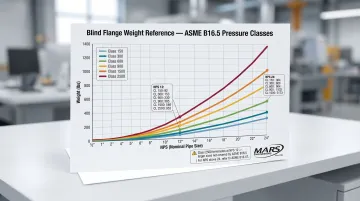
Three specification limits apply to this range:
- Class 2500 tops out at NPS 12 under ASME B16.5 — larger sizes are not available in this class
- For NPS 26" and above, ASME B16.47 Series A or B applies
- All weights shown are approximate and for carbon/alloy steel only; for stainless steel, multiply by ~1.01–1.02
How to Calculate the Weight of a Carbon Steel Blind Flange
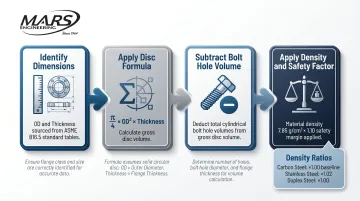
Use this formula to estimate blind flange weight, verify catalog values, or size custom geometries. It models the flange as a solid disc minus the bolt hole material:
Weight = (π/4) × OD² × Thickness × Density – (bolt hole material volume)
Where:
- OD = Outside diameter (in inches or mm)
- Thickness = Flange thickness (in inches or mm)
- Density = Material density (~7.85 g/cm³ for carbon steel)
This is an approximation. Published ASME B16.5 tables are the authoritative reference. Use the formula to sanity-check catalog values or estimate weights for custom geometries.
Material Density Adjustment
The density ratio between materials determines how flange weight scales when switching alloys:
| Material | Density (g/cm³) | Density Ratio vs. Carbon Steel |
|---|---|---|
| Carbon Steel (ASTM A105) | 7.85 | 1.00 (baseline) |
| Stainless 304/316 | 8.00 | 1.02 |
| Duplex 2205 | 7.82 | 1.00 |
To convert carbon steel weights to stainless steel, multiply by 1.02. For example:
- NPS 12 Class 150 blind flange in carbon steel: 123 lbs
- Same flange in 316 stainless: 123 × 1.02 = 125.5 lbs
These conversions assume nominal geometry stays constant — which brings up a practical limitation of any calculated weight.
Calculated vs. Actual Weight
Manufacturing tolerances (especially on OD and thickness) mean real flanges can be 5–10% heavier than nominal values. For procurement and structural load calculations, apply a 10% safety factor to published weights to account for:
- Material heat-to-heat density variations
- Fabrication tolerance accumulation
- Raised face and weld preparation mass
Pressure Class Selection and Its Impact on Weight
Higher pressure ratings require thicker flanges and larger ODs, which sharply increase weight — often disproportionately.
NPS 8 blind flange weight comparison across classes:
| Pressure Class | Approximate Weight | Weight vs. Class 150 |
|---|---|---|
| Class 150 | 47 lbs (21.3 kg) | Baseline |
| Class 300 | 85 lbs (38.6 kg) | 1.8× heavier |
| Class 600 | 156 lbs (70.8 kg) | 3.3× heavier |
| Class 1500 | 302 lbs (137.0 kg) | 6.4× heavier |
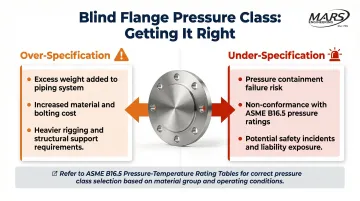
Getting the class wrong cuts both ways:
- Over-specifying (e.g., using Class 600 where Class 150 suffices) adds significant weight, material cost, and bolting requirements
- Under-specifying creates pressure containment failure risk
The correct class is determined by the pressure-temperature rating tables in ASME B16.5 for the specific material group. For ASTM A105 (Material Group 1.1), Class 150 permits approximately 285 psi at ambient temperature, decreasing with temperature.
Those rating tables, however, don't tell the whole story — shared dimensions between certain classes create a separate procurement trap:
- Class 150 and Class 300 share the same raised face diameter but differ in thickness and weight
- Class 900 and Class 1500 share dimensions for smaller sizes (NPS 1/2"–2.5")
Always verify both pressure class and dimensional specifications during procurement — a Class 300 blind flange installed in a Class 150 system can pass dimensional inspection and still fail under operating pressure.
Common Misinterpretations When Using Blind Flange Weight Charts
Treating Nominal Weights as Exact Values
The most frequent error: treating tabulated weights as exact and using them without safety factors in structural or lifting calculations. Fabrication tolerances and material heat variations can cause actual weights to deviate from published values. Engineers must apply appropriate safety margins (typically 10%) in support and rigging design.
Material Density and NPS Confusion
Two other frequent mistakes:
- Applying carbon steel weight values directly to stainless or alloy flanges without density correction, leading to underestimated loads
- Confusing NPS with actual OD—NPS is not the bore of a blind flange (which has no bore), but the pipeline size it connects to
For example, an NPS 6 blind flange has an OD of ~279 mm at Class 150, not 6 inches. The "6" is a nominal designator, not a dimension.
Conflating ASME B16.5 and ASME B16.47
These two standards cover different size ranges — and their weight tables cannot be swapped:
- ASME B16.5: Covers NPS 1/2"–24"
- ASME B16.47: Covers NPS 26"–60" (Series A = MSS SP-44; Series B = API-605)
These two standards cover different size ranges — and their weight tables cannot be swapped:
- ASME B16.5: Covers NPS 1/2"–24"
- ASME B16.47: Covers NPS 26"–60" (Series A = MSS SP-44; Series B = API-605)
The two standards use different dimensional conventions. Pulling weight data from the wrong one introduces errors that can't be corrected with a simple conversion factor.
Frequently Asked Questions
How much does a blind flange weigh?
Blind flange weight varies widely by NPS and pressure class. A Class 150 blind at NPS 1/2" weighs approximately 2 lbs (0.9 kg), while a Class 1500 blind at NPS 24" exceeds 3,600 lbs (1,631 kg). Check ASME B16.5 weight tables for the applicable class.
How much does a 24-inch flange weigh?
NPS 24 blind flange weights by pressure class: Class 150 ≈ 430 lbs (195 kg); Class 300 ≈ 800 lbs (363 kg); Class 600 ≈ 1,250 lbs (567 kg); Class 900 ≈ 2,099 lbs (952 kg); Class 1500 ≈ 3,625 lbs (1,644 kg). These are carbon steel values per ASME B16.5.
How do you calculate the weight of a flange?
Approximate weight = (π/4 × OD² × Thickness × material density) minus bolt hole material. For carbon steel, density ≈ 7.85 g/cm³. ASME B16.5 published tables are the most accurate reference; the formula works best for sanity checks or cross-material conversions.
What is the difference between 150 lb and 300 lb flanges?
Class 300 flanges are thicker and heavier than Class 150 to handle higher allowable pressures. An NPS 12 blind flange weighs ~123 lbs at Class 150 versus ~185 lbs at Class 300. Both share the same raised face diameter but differ in thickness, bolt circle, and overall weight.
What is the ASTM standard for carbon steel flanges?
The primary ASTM standard for carbon steel flanges is ASTM A105 (forged carbon steel for piping components). For low-temperature service, ASTM A350 LF2 is used. Dimensional standards (size, weight, tolerances) are governed by ASME B16.5 (NPS 1/2"–24") and ASME B16.47 (NPS 26"–60").
What is ASME B16.5 Class 150?
ASME B16.5 Class 150 is the lowest pressure rating in the standard. For carbon steel (ASTM A105), it permits approximately 285 psi at ambient temperature, decreasing as temperature rises. It's the lightest and most cost-effective option in the B16.5 family.