This guide covers how to define precision component requirements, what to evaluate in a supplier, and how to find a manufacturer capable of delivering consistent results from prototype to full production.
Key Takeaways
- High-precision custom components are parts machined to tolerances of ±0.001" or tighter using screw machining, CNC turning, milling, and EDM
- Evaluate suppliers on tolerance capabilities, equipment range, certifications, and volume scalability—not just quoted price
- Single-source manufacturers reduce lead times, cut multi-vendor coordination overhead, and lower total cost through integrated capabilities
- ISO and AS9100 certifications are required for regulated industries—they ensure traceability and documented quality systems
- Precision sourcing works best as a long-term partnership where scalability, communication, and consistency carry equal weight to initial cost
What Are High-Precision Custom Components?
High-precision custom components are manufactured parts engineered to exact customer specifications, held to strict dimensional tolerances—often ±0.001" or tighter—across materials like stainless steel, brass, aluminum, copper, titanium, and specialized alloys.
Manufacturers produce these components through multiple methods including screw machining (single and multi-spindle), CNC turning and milling, centerless grinding, Wire EDM, and various finishing processes, each suited to different part geometries, production volumes, and tolerance demands.
Standard CNC machining tolerances typically range from ±0.005" to ±0.010", while precision machining achieves ±0.002" or tighter. The tightest tolerances—down to ±0.0001"—are achieved through centerless grinding and Wire EDM, enabling the production of miniature precision components for aerospace, medical, and electronics applications.
Why Precision Matters Across Industries
In aerospace, medical devices, automotive, and electronics, component failure carries safety and regulatory consequences, not just financial ones. Tolerances directly affect how parts fit, function, and interact within larger assemblies—as these documented failures show:
- Aerospace: An NTSB investigation found out-of-tolerance blade retention slots on a Pratt & Whitney PW2037 turbine hub caused multiple lug fractures and uncontained blade release
- Medical: The FDA issued a Class I recall for endotracheal tubes with smaller-than-expected diameters, risking patient underventilation and hypoxia
- Automotive: NHTSA Recall 25V719 involved front axle stabilizer bar brackets manufactured with inner dimensions below minimum specification, leading to material fatigue and bracket detachment
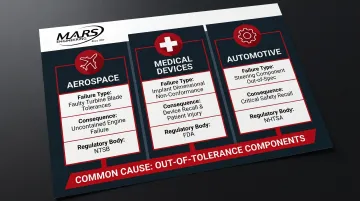
These examples share a common thread: the failure wasn't random. It was predictable from a sourcing standpoint. Across high-volume industries, consistency across a production run—not just one-off accuracy—is critical. A part that meets spec on unit one but drifts by unit 10,000 is a sourcing failure.
What to Consider When Sourcing High-Precision Custom Components
Sourcing precision components isn't just about finding a shop with the right machines. It requires aligning the supplier's capabilities with your application requirements, quality standards, and production timelines.
The factors below help buyers move beyond price-per-part comparisons toward decisions that deliver measurable outcomes: fewer rejections, faster time-to-production, and lower per-part costs over the life of the program.
Tolerance Capabilities and Verification Standards
This is the first and most critical factor: a supplier must demonstrate—not just claim—the ability to hold your required tolerances consistently, including the inspection equipment (CMMs, surface profilometers, gauge blocks) to verify them.
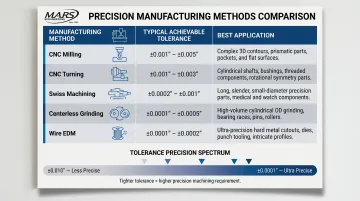
Industry-standard tolerance benchmarks by manufacturing method:
| Manufacturing Method | Typical Achievable Tolerance | Best Application |
|---|---|---|
| CNC Milling | ±0.010" to ±0.002" | Complex 3D geometries |
| CNC Turning | ±0.005" to ±0.0005" | Cylindrical parts |
| Swiss Machining | ±0.001" to ±0.0005" | High length-to-diameter ratios |
| Centerless Grinding | Sub-micron to ±0.0001" | Superior surface finish and roundness |
| Wire EDM | ±0.0005" to ±0.0001" | Hardened materials and intricate profiles |
Modern CMMs governed by ISO 10360 achieve measurement uncertainties below ±0.0001". Always request documented inspection results—not just stated capability—and verify that the supplier uses calibrated instruments traceable to recognized standards.
Manufacturing Method and Equipment Range
No single machining method is ideal for every component. The supplier's equipment mix should match the geometry, volume, and material of your parts. Multi-spindle screw machines are purpose-built for high-volume runs, while CNC milling or Wire EDM is better suited for complex geometries or tool making.
A supplier with broader in-house capabilities — turning, milling, grinding, EDM, finishing — can handle more of the production workflow without outsourcing. That consolidation matters: fewer handoffs mean fewer opportunities for tolerance drift, scheduling delays, and accountability gaps. It's also what makes certifications a meaningful signal rather than a formality.
Certifications and Regulatory Compliance
Certifications like ISO 9001:2015 and AS9100 for aerospace applications are not just badges—they represent documented quality management systems, traceability protocols, and inspection procedures that regulated industries legally require from their supply chain.
Note: If your application falls under defense or aerospace programs, verify whether your supplier's certifications align with current DLA requirements. MIL-I-45208A has been officially removed from the DLA's accepted standards list; ISO 9001:2015 or AS9100 are now the recognized baseline for those supply chains.
Verify certifications directly (not just take a supplier's word), understand the scope of what each certification covers, and ask for documentation of how non-conformances are tracked and corrected.
Single-Source vs. Multi-Vendor Manufacturing
Sourcing components from multiple specialized vendors introduces coordination overhead, tolerance stack-up risk across vendors, and longer aggregate lead times. A single-source manufacturer that handles machining, finishing, plating, and light assembly in-house eliminates these friction points.
Business impact:
- Fewer purchase orders to manage
- Single accountability for quality
- Faster prototype-to-production transitions
- Lower administrative overhead and shorter total project timelines
Production Volume and Scalability
Some manufacturers are optimized for prototype and small-batch runs, while others excel at high-volume continuous production. It's critical to verify that a supplier can accommodate both your current volume and your scale-up trajectory without requiring you to re-qualify a new vendor.
Multi-spindle screw machines perform multiple operations simultaneously, making them purpose-built for high-volume runs. In one financial analysis, a multi-spindle machine producing a part every 4 seconds (vs. 17.5 seconds on a single-spindle) reduced per-part machine cost from $0.051 to $0.033, generating significant additional profit over a 2-million-part run.
Lead Times, Communication, and Design Support
A supplier's quoted lead time is only part of the picture. Assess how responsive the supplier is during the quoting and design review process, whether they proactively flag manufacturability issues, and whether they offer Design for Manufacturability (DFM) feedback that can reduce costs before production begins.
DFM best practices include:
- Applying tight tolerances only to critical features (mating surfaces, bearing fits)
- Using standard tolerances (e.g., ISO 2768 medium) for non-critical dimensions
- Simplifying geometry and using standard hole sizes
- Selecting materials based on machinability when extreme strength is not required
Domestic suppliers generally offer shorter lead times and more direct communication — a practical advantage when regulatory jurisdiction, export controls, or fast iteration cycles are part of your program requirements.
How M.A.R.'s Engineering Can Help
M.A.R.'s Engineering is a San Leandro, CA-based precision screw machining manufacturer with nearly 60 years of experience serving aerospace, medical, automotive, electronics, marine, and industrial sectors. Their vertically integrated facility handles everything from prototype to full production runs — under one roof, with one point of accountability.
Key differentiators:
- ISO-compliant quality systems with full traceability for regulated industries, including compliance with Mil-I-45208A
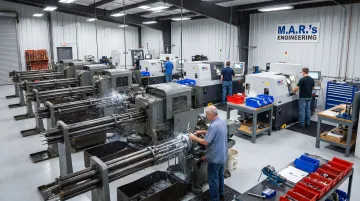
- 35 single-spindle screw machines plus a full multi-spindle lineup, covering 400–3,000 units on single-spindle and 500+ to 1 million+ on multi-spindle
- 4-axis CNC milling, centerless grinding to 4 μin finish and ±0.0001" tolerances, and in-house Wire EDM for custom tooling with minimal lead time and cost
Additional capabilities that reduce your administrative overhead:
- Runs up to 16 simultaneous operations on multi-spindle machines and up to 5 on single-spindle machines — cutting cycle time without cutting corners
- Complete in-house finishing, plating, polishing, and light assembly — no coordinating with outside vendors or chasing multiple suppliers
- Family-owned since 1964, with a customer base built largely on referrals and repeat business — the kind of track record that comes from consistently delivering on spec
Conclusion
Sourcing high-precision custom components is a decision that determines not just whether a part fits, but whether a production program runs on time, within budget, and to spec across thousands or millions of units. The right manufacturer isn't necessarily the largest or the cheapest, but the one whose capabilities, certifications, and equipment range align with your application requirements and production volume.
Supplier fit isn't static. As designs evolve and volumes shift, revisit your manufacturer's capabilities against your current needs — a shop that handled your prototype run may not be equipped for a 2,000-unit monthly program, and vice versa. Companies like M.A.R.'s Engineering, which operate across single-spindle, multi-spindle, CNC, and grinding processes under one roof, offer flexibility that accommodates that range without forcing you to re-qualify a new vendor at every production milestone.
Frequently Asked Questions
What are high-precision custom components used for?
High-precision custom components are used across aerospace, medical, automotive, and electronics industries wherever dimensional accuracy is critical to part function, safety, or regulatory compliance. Examples include turbine blade retention components in jet engines and endotracheal tubes in medical devices where tolerances directly impact performance and patient safety.
What tolerances can I expect from a precision screw machining manufacturer?
Tolerances vary by method and material, but precision screw machining routinely achieves ±0.001", while centerless grinding can achieve ±0.0001" with surface finishes as fine as 4 microinches. Always request documented inspection results with traceability to calibrated instruments.
What is the difference between single-spindle and multi-spindle screw machining?
Single-spindle machines perform up to 5 operations sequentially, suit moderate volumes (400–3,000 units), and offer faster changeover for complex or lower-volume jobs. Multi-spindle machines run up to 16 operations simultaneously, making them more cost-effective for high-volume production runs (500+ to millions of units).
How do I verify a precision component manufacturer's quality certifications?
Ask for current certification documents and confirm the scope covers your relevant processes. Key checks include:
- Verify the issuing certification body is accredited
- Ask how non-conformances are documented and resolved
- Confirm calibration records for inspection equipment are current and traceable
Should I source precision components from a domestic or overseas manufacturer?
Domestic manufacturers offer shorter lead times, easier communication, and stronger alignment with U.S. regulatory requirements like DFARS or ITAR. Overseas suppliers may reduce unit costs but introduce lead time risk and quality oversight challenges. Base the decision on total cost of ownership, not unit price alone.
How long does it take to go from prototype to full production for custom precision parts?
Timelines depend on part complexity and volume, but a single-source manufacturer that handles prototyping and production in-house cuts the transition timeline by eliminating re-qualification and vendor hand-off delays. Most transitions run weeks to a few months, depending on tooling and first article inspection requirements.