Introduction
Aerospace CNC machining operates in a world where a 0.0002″ deviation can ground a turbine blade and every component must be traced back to its material heat lot. Choosing an unqualified machining partner costs more than money — it costs flight hours, program delays, and certifications.
Unlike general industrial CNC work, aerospace tolerances commonly fall in the ±0.0005″ range, surface finishes are specified in microinches, and every operation must be documented under rigorous quality standards.
The global precision machining market is projected to reach $228.75 billion by 2033, with aerospace and defense expected to drive the fastest growth due to surging demand for complex turbine blades, landing gear assemblies, and structural components. This guide identifies five companies verified for aerospace-grade work in 2026 — selected by certifications, material expertise, and documented aerospace track records.
Key Takeaways
- Aerospace CNC machining requires tolerances of ±0.001″ or tighter, with certifications like AS9100D, ITAR, and NADCAP serving as baseline entry requirements
- Top aerospace machinists stand out through multi-axis capabilities, in-house Wire EDM tooling, and verified track records with aerospace OEMs
- Key selection criteria include AS9100D certification, exotic alloy expertise (titanium, Inconel, 7075 aluminum), sub-±0.0005″ tolerances, and single-source production
- Five companies are profiled here, each evaluated on aerospace-specific certifications, capabilities, and OEM experience
What Makes Aerospace CNC Machining Different from Standard CNC
Aerospace CNC machining operates under a far stricter rulebook than general-purpose industrial work. Where standard machining achieves tolerances around ±0.010″, aerospace tight tolerance machining typically requires ±0.001″ or better. For critical features like turbine blade mounting holes, NASA's JSC-67701 standard specifies squareness tolerances of ±0.0005 inches per inch.
Surface finishes follow equally demanding specs, with roughness (Ra) held to 63 µin for precision holes and thread surfaces.
Material Demands That Filter Out Unprepared Shops
Aerospace components regularly call for titanium alloys, Inconel, hardened stainless, and specialty aluminum grades like 7075 — materials that demand specialized cutting strategies, tooling, and hard-won experience. Nickel-based superalloys now comprise over 50% of the mass of advanced aircraft engines, while titanium alloys account for approximately 32% of the aerospace high-performance alloys market. Not every CNC shop has the tooling or expertise to machine these materials without scrapping parts.
Certifications: The Go/No-Go Filter
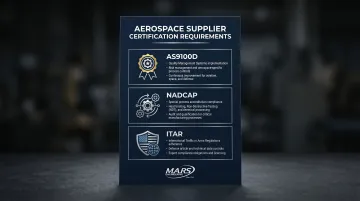
Aerospace procurement teams use AS9100D, ITAR registration, NADCAP accreditation, and Mil-spec compliance as hard go/no-go filters before evaluating any other capability:
- AS9100D: Integrates ISO 9001 with aerospace-specific requirements including operational risk management, counterfeit parts prevention, and strict configuration control
- NADCAP: Industry-managed accreditation for critical processes like nonconventional machining (EDM, ECM, laser), heat treating, NDT, and welding
- ITAR: U.S. State Department registration required for any person engaged in manufacturing defense articles, even without export activity
Shops lacking these credentials are automatically disqualified from aerospace work, regardless of machining capability.
Top Aerospace CNC Machining Companies in 2026
These companies were selected based on demonstrated aerospace credentials, technical capabilities, and their ability to support programs from prototype through production.
M.A.R.'s Engineering
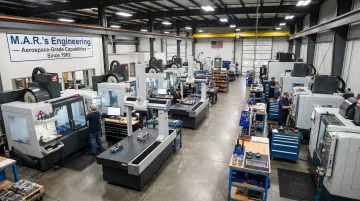
M.A.R.'s Engineering is a family-owned precision machining company founded in 1964 and based in San Leandro, California. With nearly 60 years of continuous operation serving aerospace, defense, medical, and electronics customers, its longevity and word-of-mouth growth signal deep customer trust and process stability.
For aerospace work, M.A.R.'s brings several capabilities under one roof:
- ISO 9001:2015 / AS9100D certified quality systems with full traceability and Mil-1-45208A compliance
- 4-axis CNC milling and multi-spindle screw machining handling up to 16 simultaneous operations
- Centerless grinding with surface finishes up to 4 μin and tolerances up to .0001 inches
- In-house Wire EDM for custom tooling fabrication with minimal lead time
Consolidating these operations internally eliminates multi-vendor delays, reduces per-part costs, and keeps quality control consistent from prototype through production.
| Certifications / Compliance | ISO 9001:2015 / AS9100D; Mil-1-45208A compliant |
|---|---|
| Key Capabilities | 4-axis CNC milling, Wire EDM (in-house tooling), multi-spindle screw machining (up to 16 simultaneous operations), centerless grinding, finishing and light assembly |
| Tolerances / Finishes | Tolerances up to .0001 in; surface finishes up to 4 μin |
Barnes Aerospace
Barnes Aerospace is a precision aerospace manufacturer with roots dating to 1857, headquartered in Windsor, Connecticut, specializing in machined and fabricated engine components, airframe parts, nacelle assemblies, and complex structural assemblies for commercial aviation, military, and space programs.
Barnes holds ISO 9001, AS9100, and NADCAP certifications covering nonconventional machining, non-destructive testing, and fluorescent particle inspection — a scope that relatively few precision shops carry. Equipment includes 5-axis milling up to 60″ diameter and vertical turret lathes up to 72″ diameter, with material capabilities spanning titanium, Inconel, Hastelloy, Waspaloy, and Rene 41. Aftermarket and MRO services extend the relationship beyond initial production into long-term fleet support.
| Certifications / Compliance | ISO 9001:2015, AS9100 Rev D, NADCAP |
|---|---|
| Key Capabilities | Engine component machining, airframe/nacelle fabrication, 5-axis milling, complex assembly, MRO services |
| Industries Served | Commercial aviation, defense/military, energy, space |
Howmet Aerospace
Howmet Aerospace is a Pittsburgh, Pennsylvania-based global manufacturer spun off from Arconic in 2020, focused entirely on engineered solutions for aerospace and transportation. The company produces turbine engine components, airframe structures, fastening systems, and forged wheels for leading OEMs worldwide.
Howmet's scale and vertical integration allow it to control materials, machining, and finishing in-house across multiple global facilities. Turbine blade and engine component machining demands complex superalloy geometries, multi-axis equipment, and tightly controlled process parameters — capabilities Howmet has built specifically around OEM requirements at volume. Site-specific AS9100D and NADCAP accreditations apply across facilities, and public company reporting provides additional supply chain transparency for aerospace procurement teams.
| Certifications / Compliance | AS9100D, NADCAP (site-specific); publicly traded with full regulatory compliance |
|---|---|
| Key Capabilities | Turbine engine components, airframe structures, fastening systems, forged wheels, superalloy machining |
| Industries Served | Commercial aerospace, defense, space, transportation |
United CNC Machining
United CNC Machining was founded in 1979 and is headquartered in Auburn Hills, Michigan, with over 45 years of experience and 50+ advanced CNC work centers. The company is recognized as an exotic alloy specialist serving aerospace, defense, and advanced manufacturing markets.
United holds AS9100D, ISO 9001:2015, ITAR, and CMMC 2.0 certifications, positioning it for sensitive defense and aerospace programs with cybersecurity requirements. 5-axis milling covers parts from micro size up to 130″ × 200″, while multi-axis turning reaches 34″ × 80″ diameter — meaning miniature precision components and large structural assemblies can be sourced from the same facility.
| Certifications / Compliance | AS9100D, ISO 9001:2015, ITAR, CMMC 2.0 |
|---|---|
| Key Capabilities | 5-axis CNC milling, multi-axis turning, exotic alloy machining, precision prototypes, limited production runs |
| Tolerances / Part Size Range | Micro parts through 130″ × 200″ milled parts; 34″ × 80″ Ø turned parts |
Precise Tool and Manufacturing
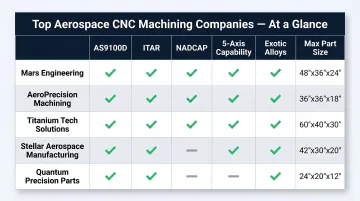
Precise Tool and Manufacturing was founded in 1974 and is based in Rochester, New York, with 100+ CNC machines and 200,000+ square feet of floor space. The company is a trusted large-part CNC machining partner for aerospace, defense, energy, and medical OEMs across the United States.
Precise Tool holds AS9100, ITAR, and American Welding Society certifications and runs a 5-axis MAZAK lineup including the VARIAXIS i-1050, which handles parts up to 49 inches in diameter and approximately 4,000 lbs. The facility is well-suited for impellers, aerospace structural components, and large complex geometries in stainless steel, aluminum, titanium, and specialty alloys.
| Certifications / Compliance | AS9100, ITAR, American Welding Society certified |
|---|---|
| Key Capabilities | Large-part 5-axis CNC machining, CNC milling and turning, rapid prototyping, welding and fabrication, assembly |
| Part Size / Material Range | Up to 49″ diameter / ~4,000 lbs; stainless steel, aluminum, titanium, specialty alloys |
How We Chose These Aerospace CNC Machining Companies
The most common mistake buyers make is choosing a CNC shop based on general capabilities or price alone without verifying aerospace-specific credentials. A shop can be highly skilled at general machining and still be unqualified for aerospace work if it lacks AS9100D certification, ITAR registration, or documented material traceability.
Primary evaluation criteria:
- AS9100D, ITAR registration, NADCAP accreditation, and Mil-spec compliance — confirming the shop operates under aerospace-grade quality systems
- 4-axis and 5-axis machining capability for complex geometries without multiple setups
- Verified tolerance performance at ±0.0005″ or tighter, with surface finishes in the microinch range
- Proven experience machining titanium, Inconel, 7075 aluminum, and hardened stainless steel
- Verifiable aerospace OEM or Tier-1 relationships — customer references, program histories, or disclosed partnerships
These criteria address program risk directly — each one maps to a failure mode that has grounded aerospace programs or inflated costs. Secondary factors then separate the best-fit shops from merely qualified ones:
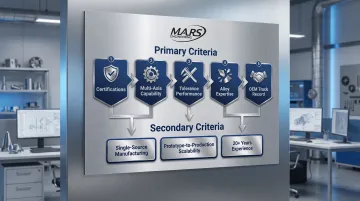
- Single-source or consolidated manufacturing capability reduces lead time and vendor management overhead
- Scalability from prototype to production — supporting 5-piece development runs through 10,000+ production quantities
- 20+ years in aerospace, signaling process stability and deep process knowledge
Conclusion
The "best" aerospace CNC machining company is the one that aligns with the specific requirements of your program—certifications, materials, part complexity, volume, and timeline. A 5-gram micro-pin for avionics requires different equipment than a 4,000-pound turbine case, and a 10-piece prototype run demands different economics than a 50,000-piece fastener program.
Beyond initial capability claims, evaluate ongoing performance factors: on-time delivery history, non-conformance rates, responsiveness to engineering changes, and scalability as programs ramp from development to full-rate production. Shops that maintain AS9100D certification year after year demonstrate consistent process discipline. Those that lose certification or fail surveillance audits typically signal deeper operational problems worth investigating before committing to a program.
For aerospace customers who need a family-owned precision shop with nearly 60 years of experience, Mil-1-45208A conformance, in-house Wire EDM tooling, and end-to-end manufacturing services from prototype through high-volume production, M.A.R.'s Engineering in San Leandro, California is worth a direct conversation.
Reach the team at 510-483-0541 or info@marseng.com to discuss your program requirements and technical specifications.
Frequently Asked Questions
Who is the best CNC manufacturer?
There is no single "best" CNC manufacturer—the right choice depends on industry requirements, part complexity, certifications, and production volume. For aerospace specifically, prioritize shops holding AS9100D and ITAR credentials with documented multi-axis capability, exotic alloy expertise, and full material traceability systems.
What is the best aluminum for CNC machining?
6061 aluminum is the most widely used for general CNC machining due to excellent machinability and cost-effectiveness. For aerospace applications where higher strength-to-weight ratio and fatigue resistance are required, 7075 aluminum is preferred—it's commonly specified for aircraft structural components and landing gear parts.
How much does CNC aluminum parts cost?
Costs vary widely based on part complexity, tolerances, volume, and finishing requirements. Prototype runs typically start around $65 per part, but tightening tolerances from standard (±0.030″) to precision (±0.001″) increases costs by approximately 4x. Aerospace-grade parts with AS9100D traceability carry an additional premium over standard commercial machining.
What is the most accurate CNC machine in the world?
Ultra-precision CNC machines from manufacturers like Kern Microtechnik (Pyramid Nano with ±0.3 µm positioning) and Moore Nanotechnology (M600 with sub-micron repeatability) achieve the highest accuracy levels. For most aerospace applications, 5-axis machining centers from Mazak, DMG Mori, or Okuma achieve tolerances in the ±0.0001″ range, which is sufficient for the vast majority of aerospace components.
Which country makes the best CNC machines?
Germany, Japan, and the United States lead in producing of high-precision CNC machine tools. German manufacturers (DMG MORI, EMAG) and Japanese manufacturers (Mazak, Okuma, Makino) are especially prominent in aerospace-grade equipment. However, machine quality matters less than the shop's expertise in operating them for aerospace work—an AS9100D-certified operator on a Japanese Mazak will outperform an uncertified shop on any equipment.
What certifications should an aerospace CNC machining company have?
AS9100D, ITAR registration, NADCAP accreditation, and relevant Mil-spec compliance are the core certifications to verify before qualifying any aerospace machining supplier. Shops lacking these credentials should be disqualified regardless of technical capability.